Industrial symbiosis in special economic zones: building the business case for sustainable growth


AuthorS: DR. Adarsh Varma,
Kyra Johnen-Thier, DR. Daniel Neumann
How can industrial symbiosis improve the competitiveness and investment attractiveness of Special Economic Zones?
Industrial symbiosis can transform industrial zones from collections of independent facilities into connected ecosystems that exchange energy, water, materials, and by-products. Our analysis shows that the greatest value comes not only from sustainability gains, but from lower operating costs, stronger resilience, and improved investment attractiveness. In an exemplary industrial-park scenario, full industrial symbiosis combined with enabling technologies demonstrated potential for up to €4 billion in annual operating-cost savings, approximately 3.2 million tons of annual CO₂ reduction, and a modeled payback period of three to ten years. These findings indicate that industrial symbiosis can be an economic growth strategy as much as a decarbonization strategy.
- Industrial symbiosis ecosystems analyzed by FEV Consulting included more than 150 participating companies across 11 benchmark locations worldwide
- Chemical, cement, steel, and energy-intensive industries appear in almost every successful industrial symbiosis ecosystem studied
- Closed-loop resource systems can support waste diversion from landfill exceeding 80 percent in leading benchmark cases
- District-heating networks are present in approximately half of the benchmark ecosystems analyzed, turning waste heat into a commercial product
Why is industrial symbiosis becoming a strategic priority for SEZs?
Special Economic Zones (SEZs) are no longer evaluated solely on land availability, infrastructure, and incentives. Investors, sovereign wealth funds, development finance institutions, and multinational companies increasingly assess zones through the lens of sustainability, resilience, and long-term economic competitiveness. For many industrial zones, the challenge is how to strengthen environmental performance without undermining profitability.
Industrial symbiosis offers an answer by treating waste streams, excess energy, and underutilized resources as economic assets rather than operational inefficiencies. This shift enables industrial zones to create value from collaboration between tenants while improving resource productivity across the entire ecosystem.
What is industrial symbiosis?
Industrial symbiosis describes the exchange of materials, energy, water, and by-products between neighboring industries so that the output of one operation becomes a valuable input for another. Companies no longer operate in isolation but become part of a connected industrial ecosystem.
Examples include recovering waste heat from cement, refining, or steel operations and supplying it to nearby facilities, upgrading lower-temperature heat through heat pumps, reusing treated wastewater, converting organic waste into biogas, and utilizing captured CO₂ in downstream industrial processes.
The result is a more productive use of resources throughout the zone, creating both environmental and economic benefits.
Why is the business case gaining momentum?
The strongest industrial symbiosis projects are driven by economics rather than compliance alone.
For industrial tenants, resource exchanges can reduce expenditure on energy, water, raw materials, waste treatment, and disposal. By-products that previously represented costs can become valuable inputs or commercial products.
For zone operators and developers, industrial symbiosis can support new operating models centered on shared utilities, resource-management services, district-energy systems, and resource-trading opportunities. The zone moves from being a landlord to becoming an ecosystem facilitator.
For investors, industrial symbiosis creates measurable performance indicators that align with increasingly important ESG and sustainability criteria while delivering operational-performance improvements that can strengthen project economics.
Just as importantly, industrial symbiosis can improve resilience. Reduced dependence on imported energy and raw materials can help mitigate exposure to commodity-price volatility, geopolitical disruption, and climate-related supply-chain risks. Sensitivity analysis within the exemplary ecosystem demonstrated financial robustness under electricity-price fluctuations of ±20 percent and gas-price fluctuations of ±30 percent.
How can developers determine where to invest?
One of the most common mistakes is selecting technologies before understanding the industrial ecosystem itself.
Our approach starts with the industrial configuration of the zone. Through a digital-twin-based simulation framework, industries are defined according to scale, production capacity, resource requirements, and operational characteristics. The model then evaluates possible exchanges and identifies the combination of technologies that maximizes economic performance, resource efficiency, and emissions reduction.
The framework compares independent industrial operation without symbiosis, partial industrial symbiosis through direct exchanges of heat, water, and materials, and full industrial symbiosis supported by enabling technologies such as renewable power, energy storage, green hydrogen, anaerobic digestion, thermal-energy systems, and carbon capture.
This allows developers, investors, and policymakers to evaluate investment scenarios before significant capital commitments are made.
What should decision-makers consider before implementation?
Industrial symbiosis is not achieved through technology deployment alone. Infrastructure requirements may include heat networks, wastewater systems, CO₂ pipelines, microgrids, digital monitoring systems, and shared utility assets. Project economics are therefore highly dependent on local conditions such as facility proximity, land availability, construction costs, and existing infrastructure.
This makes project-specific assessment essential. The exemplary industrial park modeled in our analysis demonstrated strong economic potential, but actual investment requirements and returns will vary based on the specific industrial composition and infrastructure context of each zone.
Successful implementation also requires governance structures that address resource ownership, pricing mechanisms, infrastructure access, operating responsibilities, and commercial agreements among participants. Public-private partnerships can play an important role in distributing risks while accelerating infrastructure deployment.
How can policymakers accelerate adoption?
Industrial symbiosis performs best when it is embedded into the long-term development strategy of an industrial zone.
Our analysis highlights several enabling measures, including industrial-symbiosis screening during zone planning, incentive structures linked to participation in resource-sharing networks, alignment with UNIDO Eco-Industrial Park principles, and financing mechanisms such as green bonds and PPP structures for shared infrastructure.
The objective is not simply to deploy sustainability technologies. It is to create industrial ecosystems that are more productive, more resilient, and more attractive to investors over the long term.
The whitepaper covers:
- Global industrial symbiosis benchmark ecosystems
- MENA-specific industrial-zone opportunities
- Alignment with the UNIDO Eco-Industrial Park framework
- FEV’s industrial-symbiosis modeling approach
- Technology pathways, implementation scenarios, and policy, financing, and investment recommendations
Abbreviations
CO₂ – Carbon dioxide
ESG – Environmental, social, and governance
EIP – Eco-Industrial Park
MENA – Middle East and North Africa
OPEX – Operating expenditure
PPP – Public-private partnership
SEZ – Special Economic Zone
UNIDO – United Nations Industrial Development Organization
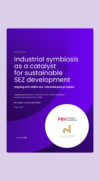
Whitepaper:
Download the full whitepaper
Industrial symbiosis represents a major opportunity for SEZ authorities, industrial-zone developers, policymakers, and investors seeking to strengthen competitiveness while advancing sustainability objectives. The greatest value often comes not from individual technologies, but from designing industrial ecosystems that allow energy, materials, water, and infrastructure to be shared more effectively across multiple industries.
Get the full whitepaper “Industrial Symbiosis as a Catalyst for Sustainable SEZ Development” on the FEV energy + resources website.
Insights:
Japanese edition of SPECTRUM 83
15 Years of Innovation This special anniversary edition celebrates 15 years of FEV Consulting and highlights our commitment to helping leading companies navigate technological change and shape the future through strategic consulting and deep technical expertise. Discover the…

Humanoid robot handling a container in an industrial environment Scaling humanoid robots in industry: what it takes to move from pilot to productivity
Humanoid robot handling a container in an industrial environment Humanoid robot handling a container in an industrial environment Author: DR. HAGEN WEGNER, Benjamin Knobloch, Dr. Dominik Boemer Can humanoid robots deliver scalable productivity in industrial…

Spectrum Article #83 featuring data center energy systems, with server racks and a magazine spread on AI-driven, power-constrained digital infrastructure. Data centers
Spectrum Article #83 featuring data center energy systems, with server racks and a magazine spread on AI-driven, power-constrained digital infrastructure. Spectrum Article #83 featuring data center energy systems, with server racks and a magazine spread on AI-driven, power-constrained digital infrastructure.